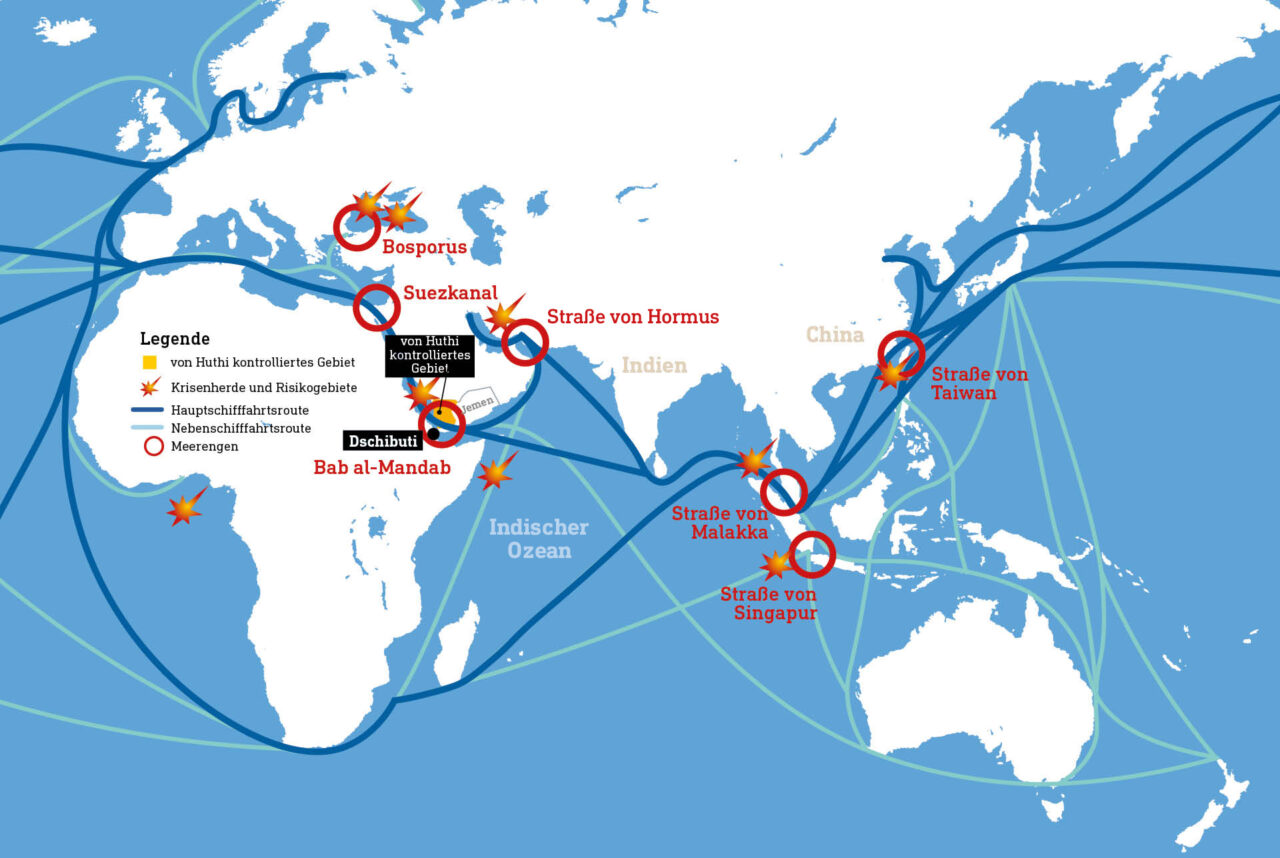
The attacks are getting bolder again: for several months, the Yemeni Houthi rebels had been observing a ceasefire brokered by Oman. But now they have resumed their attacks on civilian merchant ships. The background to this is the escalation of the situation in the Gaza Strip and the ongoing conflict between Israel and Iran whose mullah regime is a supporter of the Houthis.
Threatening e-mail received by German shipping lines
At the end of July, the militia once again spread fear and terror in the shipping industry. In an email to VDR and several member shipping companies, the Houthis threatened further targeted attacks on merchant ships. What is new is the announcement of a “fourth phase” of military escalation. The threats are now explicitly part of an expanded naval war strategy affecting worldwide civilian shipping – regardless of flag, location or sailing area.
And the ruthless terrorists mean business: at the beginning of July, the militia attacked and sank two Greek bulkers sailing under the Liberian flag. According to EU military observers, armed attackers first approached the “Magic Seas” in small boats. Then they attacked with ballistic missiles and drones. Fire broke out on board. The 22-strong crew had to abandon ship. Luckily, the crew was rescued by another merchant ship. The attack on “Eternity C” was more bloody: at least four sailors were killed and two seriously injured, with several more missing, according to the EU military mission “Eunavfor Aspides”, which operates in the Red Sea. Lloyd’s List suspects that six Filipino sailors were taken hostage by the Houthis.
According to Federal Foreign Minister Johann Wadephul, the recent attacks on merchant ships show that an ally of Iran continues to disrupt civilian shipping seriously without any reason, endangering the lives of innocent seafarers. “We condemn this in the strongest possible terms and expect Iran to exert its influence on the Houthis to put an end to this,” he said.


Already adversaries are carrying out hybrid attacks on Germany and its allies at sea.
Vice Admiral Jan Christian Kaack, Inspector of the Navy
Geopolitical power games
The escalation of the Middle East conflict has significantly exacerbated the threat situation in the key Middle Eastern sea regions. What is particularly alarming is Tehran’s threat to target civilian merchant ships in the Red Sea and the Persian Gulf. The announcement to block the Strait of Hormuz – one of the most important supply routes for global energy trade – is further aggravating the situation. “The protection of our seafarers is our top priority,” explains Gaby Bornheim, President of VDR. “Our shipping companies are monitoring developments with the utmost vigilance, are in close dialogue with the security authorities and react responsibly to every new assessment of the situation. People who work on our ships make a peaceful, indispensable contribution to the global supply of goods. They must not become the target of geopolitical power games.”
An appeal that is more than justified: According to international observers, almost 200 merchant ships have been attacked by Houthi missiles, drones or cruise missiles in the Red Sea since the end of 2023. Several ships have been sunk and numerous others severely damaged. Seafarers lost their lives.
The Red Sea trade route is the shortest sea route from Asia to Europe and accounts for 15 per cent of global maritime trade. To protect seafarers, ships and cargo, and to ensure an uninterrupted supply of important goods, shipping companies bypass the region, instead using the rout around the Cape of Good Hope, which takes 10 to 14 days longer. This, of course, has an impact on supply chains and freight rates.
According to the EU Commission’s “Integrated Situational Awareness and Analysis Report” from October 2024, the attacks by the Houthi militia on international shipping in the Bab al-Mandab Strait have led to a 73 per cent drop in shipping traffic and a 79 per cent drop in trade volume.


Numerous trouble spots
Iran and its allies are currently the most virulent threat to shipping, but by no means the only one: Since the start of the Russian aggression against Ukraine in early 2022, the Black Sea has become a danger zone for shipping. The port of Odessa is frequently under attack and parts of the shipping lanes are mined.
Ships from the Russian shadow fleet are travelling in the Baltic Sea; they are often aged oil tankers that are considered a security risk. “Adversaries are already carrying out hybrid attacks at sea below the threshold of open war, mostly targeting critical maritime infrastructure of Germany and its allies,” said naval inspector Jan Christian Kaack recently in an interview with “Deutsche Seeschifffahrt”. This includes, for example, disruption of ship navigation through GPS jamming. The naval inspector has also observed “increased aggressiveness” of Russian units.
The Taiwan Strait is another important shipping route. 180 kilometres wide, the strait is at the centre of the conflict between China and Taiwan. Beijing’s “growing military confidence in the South China Sea not only threatens the security of Asia, but also undermines the rules-based world order”, said Foreign Minister Wadephul during a recent visit to Indonesia. An escalation would have “serious consequences for global security and global prosperity”. German and European interests would be directly affected.
The number of brutal attacks by armed pirate gangs has increased again recently. The International Maritime Bureau (IMB) counted 45 attacks and attempted attacks in the first quarter of 2025. “The threat to the safety of crews remains high,” say the experts. In addition to the east coast of Africa (including offshore Somalia), the Strait of Malacca off Singapore has become another hotspot. The shortest connection between the Indian Ocean and the South China Sea is one of the world’s most important trade routes. The number of attacks there has quadrupled recently.
Military involvement
Naval forces are often deployed to protect merchant ships: as part of Operation Atalanta between 2009 and 2022, German naval ships accompanied transports of the UN World Food Programme, helping to protect merchant ships around the Horn of Africa against pirate attacks.
The “Aspides” mission to protect against Houthi attacks is currently in action, with Bundeswehr involvement since February 2024, initially by the frigate “Hessen”, for example. The aim of the defensive operation is to preserve freedom of commercial shipping. The operational area includes the Bab al-Mandab Strait and the Strait of Hormuz as well as the international waters in the Red Sea, the Gulf of Aden, the Arabian Sea, the Gulf of Oman and the Persian Gulf, including the airspace above them. Up to 700 German soldiers can be deployed according to the relevant Bundestag resolution. Foreign Minister Wadephul recently expressed his openness to extending the mandate.
The German government has reaffirmed the protection of German merchant shipping and of the free flow of goods and trade as a security task within the National Security Strategy. The Federal Government’s evaluation report on the Bundeswehr’s current, mandated international missions has confirmed that the Bundeswehr’s contributions to securing geostrategically important regions and critical trade routes are of great importance.
Clear demand
“The freedom of sea routes is in the fundamental strategic interest of Germany and all other trading nations,” says naval inspector Kaack. After all, around 90 per cent of global trade is carried out by sea.
“Protecting merchant shipping is a humanitarian duty – not an option,” emphasises VDR Chief Executive Officer Martin Kröger. “The international community must make unmistakably clear that civilian merchant shipping is not a legitimate target of military force.”